
You park your car after a short drive and notice a faint sweet smell near the hood. There’s no puddle underneath, and the temperature gauge looks normal. A few days later, you check the coolant reservoir and find the level has dropped again.
That could be an early coolant leak. Some leaks leave obvious wet spots, while others escape only when the cooling system is hot and pressurized. The leaking coolant may even evaporate before reaching the ground.
Recognizing coolant leak symptoms early gives you a better chance of finding the problem before the engine overheats.
Here’s what to look for, where coolant commonly escapes, and how to identify the source without replacing parts unnecessarily.
Quick AnswerCommon coolant leak symptoms include colored puddles, a sweet antifreeze smell, repeated coolant loss, dried deposits around cooling components, foggy cabin windows, persistent white exhaust, and abnormal heating or engine temperature. A leak can exist without a puddle or an overheating warning. A cooling-system pressure test is often the most useful next step when visual inspection doesn’t reveal the source.
What Is a Coolant Leak, and Why Does It Matter?
Engine coolant absorbs heat and carries it through the cooling system, where the radiator helps release that heat.
The system normally operates under controlled pressure to maintain effective cooling.
An external coolant leak occurs when fluid escapes through a hose, radiator, water pump, reservoir, housing, or another cooling-system component.
An internal coolant leak can occur when coolant enters an engine cylinder, oil passage, or another system through a failed gasket or damaged component.
Either problem can reduce coolant quantity and introduce air into the system. Repeatedly adding coolant may temporarily restore the level, but it doesn’t repair the leak.
7 Coolant Leak Symptoms You Shouldn’t Ignore
01 Colored Puddles or Wet Spots Under Your Car
A puddle beneath the engine compartment is one of the easiest signs of a coolant leak to recognize.
Coolant may appear green, orange, pink, yellow, blue, or another color depending on its formulation.
However, color alone cannot tell you which coolant specification your vehicle requires.
A leaking radiator, hose, or water pump can leave fluid on the ground after parking.
Keep in mind that coolant may travel along engine parts or underbody covers before dripping. The position of the puddle doesn’t always identify the failed component.
Clear water dripping after A/C use is often normal condensation, not antifreeze.

First check: Look beneath the vehicle after parking and inspect accessible areas only after the engine cools. Never taste or directly handle unknown automotive fluids.
02 Sweet Coolant Smell After Driving
A sweet or syrup-like odor near the engine can be an early warning that antifreeze is escaping.
Small amounts of coolant may land on a hot engine surface and evaporate before leaving a visible puddle.
You might smell it after shutting off the engine, while sitting in traffic, or when the heater fan is running.
If the odor seems stronger inside the cabin, a heater-core leak is one possibility.
But smell alone cannot determine which component is leaking. Other fluids and chemicals can also produce unusual odors.

First check: Once everything is cool, inspect visible hose connections, radiator seams, and the area around the coolant reservoir for wetness or residue.
03 Coolant Reservoir Level Keeps Dropping
In a properly functioning cooling system, coolant should not need frequent topping off.
If the reservoir repeatedly falls below its normal cold level, coolant may be escaping somewhere.
Always compare readings under similar conditions. Coolant expands when hot, so a warm reservoir level can look different from a cold reading.
After recent cooling-system work, trapped air may also move out of the system and change the reservoir reading.
However, continued coolant loss after the system has been properly filled and bled requires investigation.
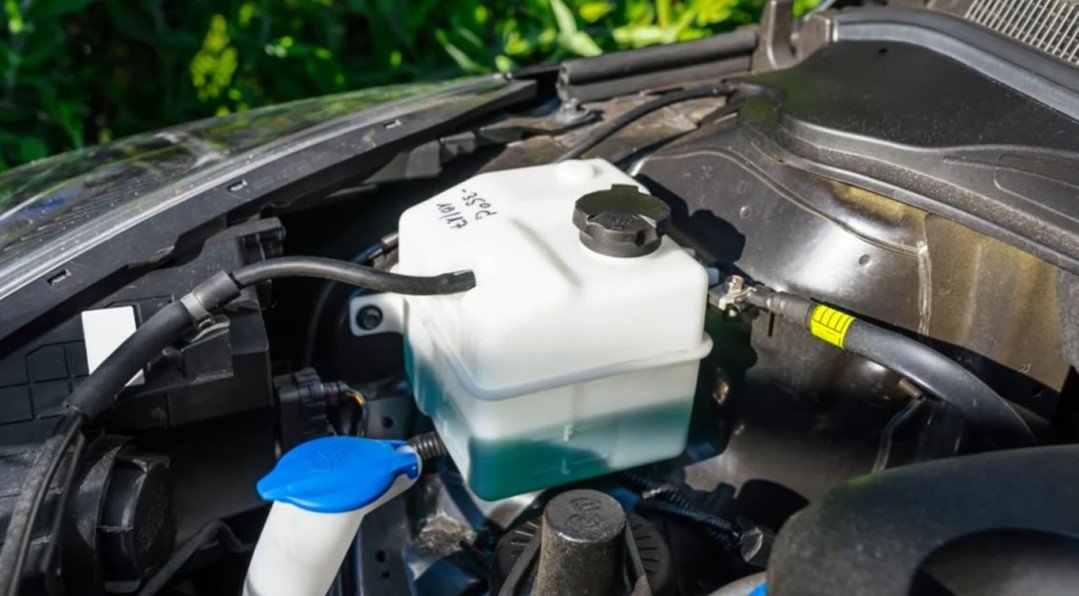
First check: Follow the owner’s manual to check the coolant level when the engine is cold. Repeated loss or a low-coolant warning deserves a cooling-system inspection.
If coolant loss is accompanied by other engine problems, our guide to common car problems covers additional warning signs worth considering.
04 Dried Coolant Residue Around Hoses and Engine Parts
Coolant doesn’t always leave a wet surface by the time you inspect the engine.
As it evaporates, additives and dissolved materials may leave crusty or colored deposits.
Common areas include radiator end tanks, hose connections, thermostat housings, and the water pump area.
A failing water pump seal may leave staining around its weep hole or housing.
But old stains sometimes remain after a previous repair, so deposits alone don’t always prove an active leak.
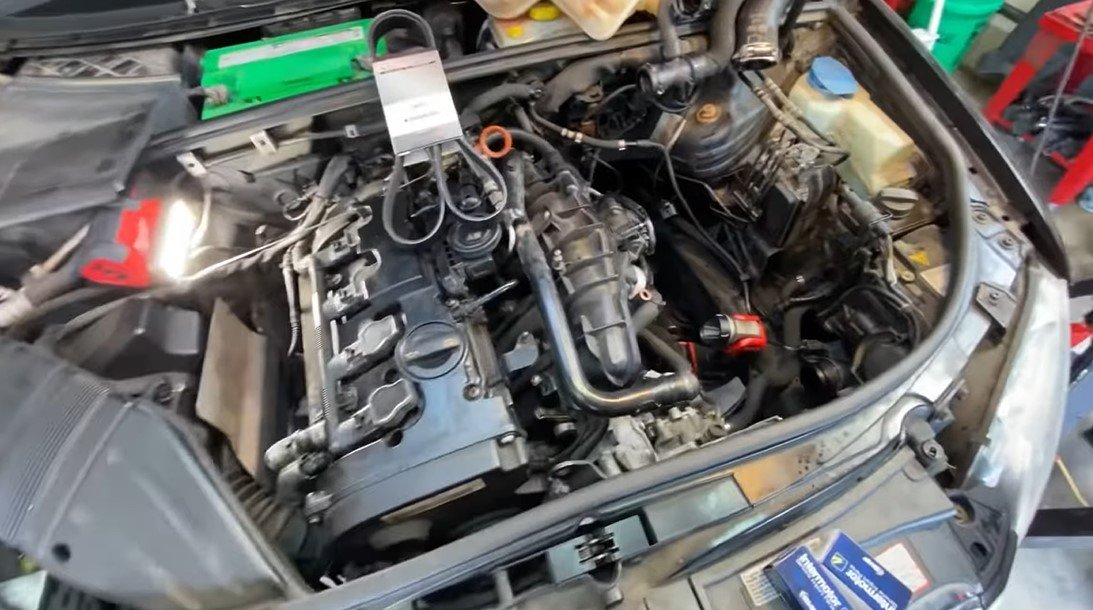
First check: Look for fresh moisture, growing deposits, or staining that returns after cleaning. Confirm the source before replacing a radiator, pump, or housing.
05 Foggy Windows, Sweet Cabin Smell, or Damp Carpet
A heater core is a small heat exchanger inside the vehicle’s heating and ventilation system.
When it leaks, coolant may collect inside the HVAC housing or escape into the passenger compartment.
Possible clues include a sweet smell through the vents, persistent windshield fogging, a greasy-looking film on the glass, or damp carpeting near the front footwell.
However, a blocked A/C drain or rainwater entering through a door seal can also make carpeting wet.
Cabin moisture alone isn’t enough to confirm a heater-core leak.
First check: Compare cabin symptoms with the coolant level. If sweet-smelling moisture or windshield film is present, have the heater core and HVAC housing inspected.
06 Persistent White Exhaust and Unexplained Coolant Loss
Coolant entering an engine cylinder can produce persistent white exhaust vapor, particularly after the engine reaches operating temperature.
A damaged head gasket, cracked cylinder head, or another internal engine fault may allow this to happen.
You may also notice rough running after startup or unexplained coolant loss without any external leak.
But ordinary condensation often produces white vapor during cold weather, especially shortly after startup.
Likewise, milky-looking engine oil may suggest contamination, but one observation doesn’t prove a blown head gasket.
First check: If white exhaust persists after warm-up and coolant repeatedly disappears, request targeted internal-leak testing. Don’t authorize head-gasket replacement based on smoke color alone.
07 Heater Blows Cold, Temperature Rises, or Steam Appears
A cooling system that’s losing coolant may eventually struggle to circulate fluid properly.
One early clue can be a cabin heater that suddenly stops producing warm air because of low coolant or trapped air.
As the problem worsens, the temperature gauge may rise, a warning light may appear, or steam may escape from the engine compartment.
However, a heater blowing cold can also result from thermostat, blend-door, or heater-core problems unrelated to a leak.
Overheating isn’t always the first symptom. A slow leak may exist for days or weeks before the temperature becomes abnormal.
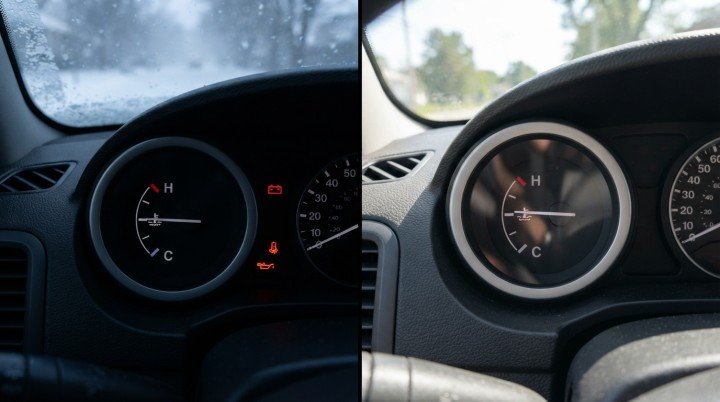
First check: If the temperature rises or steam appears, pull over safely and shut off the engine. Check coolant only after the entire system cools.
Never remove a radiator cap or pressurized coolant reservoir cap while the engine is hot. Escaping steam and coolant can cause serious burns. Keep children and pets away from antifreeze spills because engine coolant can be toxic if swallowed.
External vs. Internal Coolant Leaks: How to Tell the Difference
Identifying whether coolant is escaping outside the system or entering another engine passage helps determine the correct test.
| Clue | External Leak | Internal Engine Leak |
|---|---|---|
| Visible puddle | Possible | Usually absent |
| Residue around hoses | Common | Usually absent |
| Persistent white exhaust | Not typical | Possible |
| Coolant mixed with oil | Not typical | Possible |
| Repeated coolant loss | Possible | Possible |
| Typical testing | Visual inspection, pressure test, UV dye | Pressure test plus targeted internal-leak tests |
A heater core can leak into the passenger cabin without involving an internal engine gasket failure.
No single symptom definitively distinguishes every external leak from an internal one.
Where Does Coolant Usually Leak From?
Different cooling components leave different clues. This comparison can help you understand what a mechanic is checking.
| Possible Source | What You May Notice |
|---|---|
| Radiator | Moisture or crusty deposits at seams, tubes, or plastic end tanks |
| Radiator or heater hose | Wet connections, cracked rubber, staining near clamps |
| Water pump | Residue near the pump seal, housing, or weep hole |
| Thermostat housing | Coolant around a gasket, O-ring, or cracked plastic housing |
| Coolant reservoir or cap | Moisture around seams, fittings, or pressure-cap area |
| Heater core | Sweet cabin odor, damp carpet, fogged windshield |
| Head gasket or internal passage | Unexplained coolant loss, possible exhaust vapor or fluid contamination |
| Oil or transmission cooler | Possible fluid cross-contamination on applicable designs |
Remember that coolant can travel along hoses, brackets, and engine surfaces before dripping. A puddle near the passenger side doesn’t necessarily mean the component directly above it is leaking.
Coolant Leak but No Puddle: Where Is the Coolant Going?
Some of the most confusing coolant leak symptoms happen when the reservoir keeps dropping but the driveway stays dry.
Several explanations are possible:
- Evaporation: A small leak drips onto a hot engine or exhaust component.
- Pressure-dependent leak: A gasket or connection leaks only when the system becomes hot and pressurized.
- Hidden collection: Coolant gathers on an engine splash shield instead of reaching the ground.
- Pressure-cap problem: Coolant escapes through an incorrect or defective cap or overflow route.
- Heater-core leak: Fluid escapes inside the HVAC housing.
- Internal leak: Coolant enters an engine cylinder or another fluid circuit.
A normal dashboard temperature reading doesn’t eliminate these possibilities. Small leaks can develop well before overheating begins.
How to Find a Coolant Leak Safely
Start with simple observations. You don’t need to remove engine parts or open a hot cooling system.
- Let the engine cool completely. Never open a hot cooling-system pressure cap.
- Check the coolant level. Follow the manufacturer’s cold-level procedure.
- Inspect accessible hoses and connections. Look for wetness, deposits, or damage.
- Look around the radiator and reservoir. Check visible seams and fittings.
- Check the cabin. Note sweet odors, unusual windshield film, or damp carpet.
- Track repeated coolant loss. Compare readings only under similar cold conditions.
- Request a pressure test. Small or hidden leaks often require professional testing.
- Investigate internal leakage if needed. Ask what evidence supports additional engine testing.
If the leak location remains unclear, don’t replace the water pump or radiator simply because those components commonly fail.
How Do Mechanics Confirm a Coolant Leak?
Cooling-System and Pressure-Cap Tests
A technician can pressurize the cooled cooling system using a suitable test tool and the manufacturer’s specified pressure limit.
This may expose small hose, radiator, housing, or water pump leaks that aren’t visible during a normal inspection.
The pressure cap may also require separate testing.
Pressure loss indicates a problem worth investigating, but it doesn’t automatically prove a head-gasket failure.
UV Dye Inspection
Compatible fluorescent dye may be added to the coolant so escaping fluid becomes easier to trace using the proper inspection light.
This is particularly helpful when the leak is small, difficult to reach, or only occurs under certain operating conditions.
Combustion-Gas and Internal-Leak Tests
If coolant disappears without a confirmed external leak, a technician may use a combustion-gas test, cylinder leak-down test, or other manufacturer-approved procedure.
Results must be interpreted together with the vehicle’s symptoms. No single test is perfect in every situation.
Can an OBD2 Scanner Detect a Coolant Leak?
An OBD2 scanner cannot normally identify a leaking radiator hose, cracked reservoir, or failed gasket directly.
However, it can help evaluate the effects of coolant loss and other cooling-system faults.
What a Basic Scanner Can Show
Many OBD2 scanners can display engine coolant temperature (ECT) and retrieve temperature-related trouble codes when the vehicle stores them.
Codes such as P0115–P0119 concern coolant-temperature sensor circuits or performance. P0128 generally relates to coolant temperature being below the thermostat-regulating temperature.
These codes don’t prove coolant is leaking.
For a broader explanation of fault codes, see our OBD2 codes and diagnostic procedure guide.
What Advanced Scanners May Show
On supported vehicles, enhanced tools may provide coolant-level information, cooling-fan commands, electric water pump faults, and additional temperature data.
Live-data recording can help when an overheating complaint occurs only under specific conditions.
Our Innova 5610 review explains enhanced diagnostic capabilities, while the Innova 5510 vs. 5610 comparison discusses differences between two scanner options.
Another example of a tool offering live-data display and recording is covered in our Actron CP9670 scanner review.
Why Normal Scanner Readings Don’t Rule Out a Leak
An engine may lose coolant slowly while its temperature stays within the normal range.
The temperature sensor measures local temperature, not the total amount of coolant inside the system.
Very low coolant or trapped air can also make temperature readings less representative of conditions elsewhere in the engine.
Important: Scanner data is supporting evidence, not a leak detector. If you’re unfamiliar with onboard diagnostics, our guide explaining how OBD2 works covers what diagnostic systems monitor and why physical testing is still necessary.
Coolant Leak vs. Normal A/C Condensation
It’s normal for many vehicles to drip clear water beneath the passenger compartment after air-conditioning use.
Coolant may leave colored residue or have a noticeable odor, although appearance varies by formulation.
The location of the puddle alone isn’t conclusive.
If fluid is unidentified, avoid direct skin contact and don’t taste it. A mechanic can inspect the fluid and identify the source.
Why Is My Coolant Low After a Recent Repair or Coolant Change?
After a cooling-system repair, remaining air pockets may move out as the system completes its normal bleeding process. This can change the reservoir level.
But repeated coolant loss may indicate an incorrectly seated hose, leaking clamp, damaged housing seal, loose fitting, or an incomplete repair.
The cooling system must be filled and bled according to the manufacturer’s procedure.
Don’t assume continued coolant loss is normal simply because the system was serviced recently.
What Should You Do If Your Car Is Leaking Coolant?
| What You’re Seeing | Recommended Action |
|---|---|
| Small suspected seep, temperature normal | Arrange prompt leak inspection; don’t assume it will stay small |
| Coolant repeatedly drops | Request pressure testing and source identification |
| Reservoir empty or substantial coolant loss | Avoid driving until the system is assessed |
| Steam or overheating warning | Pull over safely and shut off the engine |
| Possible coolant contamination in oil | Avoid operating the engine; request professional testing |
| Persistent white exhaust and coolant loss | Investigate possible internal leakage |
Use only coolant meeting the vehicle manufacturer’s specification. Coolant color by itself isn’t a reliable guide to compatibility.
Topping off does not remove the underlying cause and shouldn’t be treated as permission to continue driving with a significant leak.
How Much Does It Cost to Fix a Coolant Leak in 2026?
The final cost depends on which component failed and how much labor is needed to reach it.
According to RepairPal’s September 2026 national estimate, coolant leak diagnosis generally costs $60–$88 in labor, before taxes, fees, and any required repairs.
| Repair | Typical Cost Consideration |
|---|---|
| Accessible hose or clamp | Often lower-cost compared with major component repairs |
| Pressure cap or coolant reservoir | Usually lower to moderate, depending on design |
| Thermostat housing | Depends on location and whether the housing is integrated |
| Radiator replacement | Moderate to substantial, depending on vehicle |
| Water pump replacement | May be labor-intensive, especially when driven by the timing system |
| Heater core replacement | Often expensive because dashboard removal may be required |
| Head gasket or internal engine repair | Potentially several thousand dollars |
Ask whether the quote includes diagnosis, parts, labor, replacement coolant, and the correct refill and bleeding procedure.
An accurate diagnosis is usually less expensive than repeatedly replacing parts based on assumptions.
Should You Use a Coolant Stop-Leak Product?
Coolant stop-leak products are sometimes marketed as a quick way to seal small leaks.
However, they don’t identify the original failure and may contaminate or restrict narrow passages in the radiator or heater core.
They also cannot reliably repair every damaged hose, gasket, or engine component.
Check manufacturer guidance before adding chemicals to the cooling system. Identifying and repairing the leaking component is generally the better long-term solution.
Can You Drive With a Coolant Leak?
Even a small leak can become worse as temperature and pressure increase.
A normal gauge doesn’t guarantee the cooling system is healthy, and there is no reliable safe driving distance for an unresolved leak.
If coolant is disappearing quickly, the reservoir is empty, steam appears, or the engine overheats, don’t continue driving.
Stop driving and arrange assistance if:
- The engine temperature rises abnormally.
- Steam or coolant spray comes from the engine compartment.
- Coolant is leaking heavily.
- The low-coolant warning appears with other cooling problems.
- The engine runs poorly with evidence of internal coolant loss.
Continuing to drive an overheating engine can cause expensive cylinder-head or internal engine damage.
How to Prevent Coolant Leaks
- Use coolant that meets the manufacturer’s specification.
- Follow the vehicle’s recommended cooling-system service schedule.
- Inspect accessible hoses, clamps, and reservoir condition.
- Repair small leaks before significant coolant loss occurs.
- Follow proper filling and air-bleeding procedures after service.
- Investigate temperature warnings and recurring coolant loss promptly.
Frequently Asked Questions
1. What is the first sign of a coolant leak?
A falling coolant level, sweet odor, or small wet spot may be the earliest clue. Some leaks produce no visible puddle, so repeated cold-level checks can be especially useful.
2. Can a coolant leak happen without leaving a puddle?
Yes. Coolant can evaporate on hot surfaces, escape only under pressure, collect on splash shields, or leak internally. A pressure test may be needed to locate it.
3. Why do I smell coolant when my car isn’t overheating?
A small external leak may evaporate on hot engine parts without lowering coolant enough to trigger overheating. Heater-core leakage can also produce an odor inside the cabin.
4. Can a coolant leak cause white exhaust smoke?
Yes, if coolant enters a combustion chamber. But temporary white vapor during cold starts can be normal condensation. Persistent warm-engine exhaust combined with coolant loss requires professional diagnosis.
5. Can an OBD2 scanner detect a coolant leak?
Not directly in most vehicles. A scanner may show temperature readings, warning-related data, or cooling-system codes, but a visual inspection and pressure test are generally needed to locate the leak.
6. How far can you drive with a coolant leak?
There is no guaranteed safe distance. The risk depends on how quickly coolant escapes and which part is leaking. Significant coolant loss, steam, or overheating means stop and arrange roadside assistance.
Final Thoughts
Recognizing coolant leak symptoms early can prevent a small hose or seal problem from turning into a major overheating repair.
Watch for puddles, sweet odors, dried residue, repeated coolant loss, cabin moisture, and unusual exhaust.
More importantly, confirm where the coolant is escaping before replacing the radiator, water pump, or head gasket. A proper inspection and pressure test can save money while protecting your engine.