
Three warning lights appear on the same dashboard: Check Engine, ABS, and airbag.
The car owner connects an inexpensive OBD2 reader and receives one result:
P0562 — System Voltage Low
The scanner finds no additional codes. That could make it appear that the ABS and airbag systems have no stored faults, but that is not necessarily what the scan result means. The reader may have checked only the standardized OBD2 information available through the emissions-related diagnostic layer.
A technician later connects a vehicle-compatible enhanced scanner. It retrieves the same P0562 code, but it also communicates with the ABS, airbag, and body-control modules. Those modules contain additional low-voltage or communication faults that the first reader could not access.
Both scanners used the same diagnostic connector. Neither result was automatically wrong. They simply asked different parts of the vehicle for information.
That difference is the key to understanding Generic vs Enhanced OBD2 Codes. The important question is not only which codes exist, but also which control modules and data networks a scanner is capable of reaching.
Case File, Scan A: The Generic OBD2 Layer
Generic OBD2—also called global OBD2—provides a standardized way to access emissions-related diagnostic information. This standardization allows a compatible scanner to communicate with OBD2-compliant vehicles from many different manufacturers.
A generic scan may provide:
- Confirmed, pending, and permanent emissions-related trouble codes
- Check Engine Light status
- Readiness-monitor results
- Freeze-frame information
- Standardized live-data parameters
- Vehicle and protocol information
Exact availability depends on the vehicle and scanner. A basic code reader may display only codes and readiness status, while more capable generic tools may graph fuel trims, oxygen-sensor data, coolant temperature, engine speed, and other standardized parameters.
What P0562 Tells Us—and What It Does Not
In the opening case, P0562 identifies a system-voltage condition detected by the powertrain controller. Because it is a standardized code, its basic definition remains consistent across OBD2 vehicles.
That information is valuable. Low system voltage can affect several electronic modules and may help explain why multiple warning lights appeared around the same time.
However, P0562 does not prove that the battery is defective. Low voltage could result from a charging-system problem, excessive resistance in a cable or ground connection, a power-supply interruption, or voltage dropping during a particular operating condition.
The code identifies the area where the controller detected a problem. It does not name the part that must be replaced.
Why a Generic Scan Is Still an Important First Step
The first scanner did not provide a complete vehicle report, but its result should not be dismissed. Generic OBD2 is especially useful when the Check Engine Light is on, an emissions inspection is approaching, or a driver needs a quick first look at engine-related data.
Its greatest advantage is consistency. A single generic reader can usually retrieve standardized emissions information from many makes and models without requiring a separate software package for each manufacturer.
Generic data can also offer useful context. Freeze-frame information may show engine speed, load, temperature, and fuel-system conditions from the moment a fault was stored. Readiness monitors can reveal whether the vehicle’s emissions self-tests have completed since codes were cleared or power was disconnected.
The limitation is scope. A generic scan reporting “no codes” generally means it found no accessible emissions-related codes through that diagnostic mode. It does not guarantee that the ABS, airbag, transmission, body, steering, or other control modules are fault-free.
Reading the Five-Character Code Correctly
A standard diagnostic trouble code contains five characters. The first letter indicates the broad system:
- P refers to powertrain.
- B refers to body.
- C refers to chassis.
- U refers to network communication.
The next character helps distinguish standardized and manufacturer-reserved code ranges, but the common rule is more nuanced than “0 means generic and 1 means manufacturer-specific.”
For powertrain codes, P0, P2, and portions of the P3 range are standardized. P1 and other portions of P3 are reserved for manufacturer-specific use. Body, chassis, and network codes also contain standardized and manufacturer-controlled ranges, so each full code should be interpreted using the correct vehicle information.
A code beginning with P is not automatically generic, and a B, C, or U code is not automatically proof that an advanced scanner can read it. Scanner access depends on the diagnostic mode, module, network, software, and vehicle coverage.
Case File, Scan B: The Scanner Enters the Rest of the Vehicle
The technician begins the second scan by identifying the vehicle’s make, model, year, engine, and diagnostic network. Instead of requesting only standardized emissions information, the enhanced scanner searches for every supported control module.
The report is now much larger.
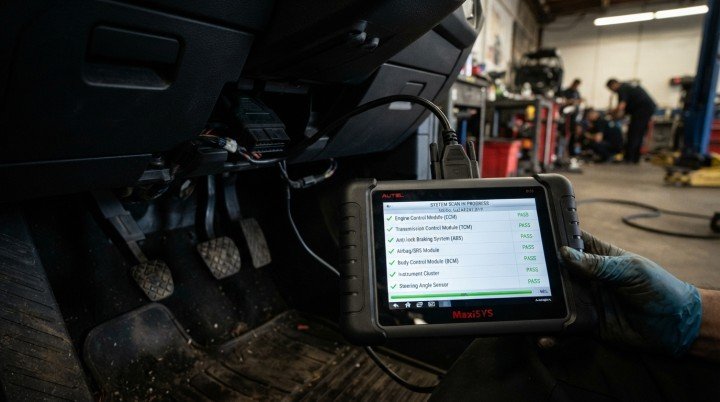
The powertrain controller still shows P0562. The ABS module reports a voltage-supply fault. The airbag module contains a low-voltage history code, and the body-control module has stored a communication fault from the same general period.
The comparison between Generic vs Enhanced OBD2 Codes now reveals its practical value. The basic reader found the powertrain’s version of the event. The enhanced scanner collected evidence from several modules affected by that event.
What “Enhanced Diagnostics” Actually Means
Enhanced diagnostics is not one additional universal OBD2 mode. It is a broad industry term for vehicle-specific access that goes beyond the standardized emissions layer.
A compatible scanner uses manufacturer-specific software and communication commands to enter supported modules. Depending on the vehicle and tool, those modules may include:
- ABS and stability control
- SRS or airbag
- Automatic transmission
- Body Control Module
- Electronic power steering
- HVAC
- TPMS
- Parking-assist and other convenience systems
The scanner may retrieve OEM-specific trouble codes, status information, and live-data parameters that are unavailable through generic OBD2. This is why a professional scanner can often find faults behind warning lights that produce no result on a basic code reader.
However, enhanced access does not change what a diagnostic trouble code is. The code still identifies a detected fault area or operating condition—not necessarily the failed part.
What the Second Scan Adds to the Case
Finding related voltage faults in several modules changes the direction of diagnosis. Instead of treating the engine, ABS, and airbag lights as three unrelated failures, the technician can investigate whether they share a power-supply event.
That evidence might lead to tests of battery condition, charging voltage, cable connections, grounds, and module power supplies. The additional codes make the pattern clearer, but they do not prove which component caused the voltage to fall.
The opposite situation is also possible. An enhanced scan might reveal that the ABS light is caused by a wheel-speed sensor circuit while the Check Engine Light has an unrelated emissions code. More access does not always uncover one shared problem; sometimes it confirms that multiple problems exist.
Evidence Board: What Each Diagnostic Layer Can Access
The Coverage Trap
A scanner advertised as “enhanced” does not necessarily provide complete access to every vehicle.
Coverage may change by manufacturer, model, production year, module, and diagnostic network. A tool might retrieve OEM trouble codes from a particular vehicle but lack OEM live data. It may support ABS and SRS on one brand while offering only engine and transmission coverage on another.
Hardware matters too. Some vehicles use more than one communication network. An adapter that cannot reach a particular network may miss modules even when the app contains the correct code definitions.
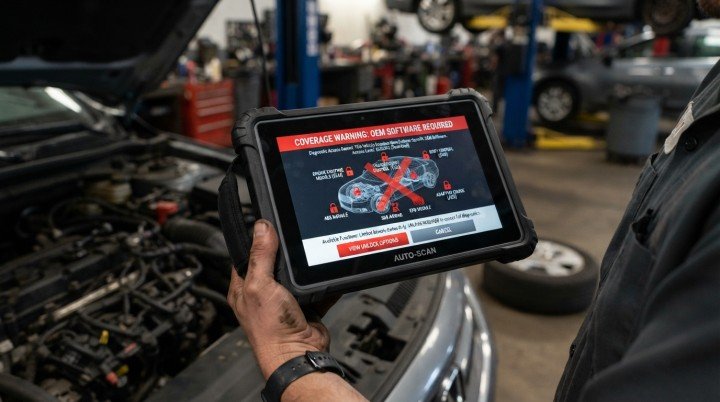
Software can introduce additional limits. Enhanced coverage may require a manufacturer add-on, paid subscription, current update, or correct VIN selection. A broad product claim should therefore be checked against the manufacturer’s detailed coverage list.
Enhanced diagnostics should also not be confused with bidirectional control. Reading a code from an ABS module does not automatically mean the tool can command the ABS pump, perform a brake-bleed procedure, calibrate a sensor, or reset a learned value.
Final Verdict: Which Diagnostic Layer Is Better?
The answer depends on the warning light and the question being asked. In the Generic vs Enhanced OBD2 Codes comparison, enhanced diagnostics provides greater depth and broader module access—but generic OBD2 remains the more universal starting point.
Generic access is usually enough when the Check Engine Light is on, emissions readiness needs to be checked, or standard engine data is required. It is affordable, works across many vehicle brands, and can reveal useful freeze-frame and fuel-control information.
Enhanced access becomes more valuable when the ABS, airbag, transmission, steering, or another non-engine warning light appears. It is also the better choice when a basic reader reports no codes even though the vehicle clearly has a module-specific problem.
The most capable diagnostic approach uses both layers: generic OBD2 for the standardized baseline and enhanced scanning for vehicle-specific context.
Five Questions to Ask Before Buying a Scanner
1. Does It Support the Exact Vehicle?
“Works with OBD2 vehicles” may refer only to generic emissions functions. Confirm the vehicle’s make, model, model year, and engine where required.
2. Which Modules Can It Scan?
Look for a detailed coverage list. ABS support does not automatically include SRS, transmission, body, steering, HVAC, or every other module.
3. Does It Read Codes Only—or Live Data Too?
A scanner may retrieve OEM codes without displaying manufacturer-specific sensor values. Those are separate capabilities.
4. Are Active Tests and Service Functions Included?
Enhanced code access does not guarantee bidirectional controls, ABS bleeding, battery registration, sensor calibration, or service resets.
Case Resolution: Codes Are Evidence, Not Replacement Instructions
Returning to the opening case, the enhanced report found voltage-related faults across several modules. That pattern suggests a shared electrical event deserves investigation before multiple modules or sensors are replaced.
A sensible diagnostic sequence is to save all codes and available freeze-frame information before clearing anything. Next, compare which faults are current, pending, stored, or historical. Then look for a common clue, such as low voltage, lost communication, or a shared power supply. The suspected system should be tested before any replacement decision is made.
If ABS or airbag warnings remain on, clearing their codes does not restore the system or prove that it is safe. These safety-related faults should be properly diagnosed by a qualified technician.
Frequently Asked Questions
Can a Basic Scanner Read Manufacturer-Specific P-Codes?
Sometimes. A basic reader may retrieve certain manufacturer-specific powertrain codes if the vehicle reports them and the tool contains the correct definitions. That does not mean it can scan ABS, SRS, or body modules.
Are All ABS and Airbag Codes Enhanced Codes?
ABS and SRS access is generally considered enhanced because those systems are outside the standardized emissions requirement. However, the individual codes may use standardized or manufacturer-reserved ranges.
Does Enhanced Diagnostics Mean Bidirectional Control?
No. Reading codes and live data is different from commanding components. Bidirectional tests must be specifically listed for the vehicle and module.
Why Does a Mechanic’s Scanner Find More Codes?
Professional tools may communicate with additional networks and control modules, use OEM-specific software, and contain broader vehicle coverage than a basic reader.
Can an Enhanced Scanner Diagnose Every Module?
Not automatically. Coverage varies by tool, software version, vehicle, model year, and network. Even an expensive scanner may have gaps.
Closing the Case
The basic scanner in our case was useful because it revealed a standardized voltage code. The enhanced scanner was more complete because it found related evidence inside the ABS, airbag, and body modules.
That is the practical conclusion to Generic vs Enhanced OBD2 Codes: generic diagnostics gives you a consistent first layer, while compatible enhanced diagnostics can show more of the vehicle. Neither code type identifies a failed part by itself, so better access must still be followed by proper testing.