
A weak battery does not always announce itself with a completely dead engine. It may begin with slower cranking, flickering dashboard lights, unusual warning messages, or several unrelated trouble codes appearing at the same time. Connecting a scanner can uncover useful electrical clues—but those clues need to be interpreted correctly.
An OBD2 scanner may display system voltage, record voltage-related trouble codes, and show how electrical supply changes while the engine is starting or running. Some advanced tools can also access battery-management data. However, a voltage reading alone cannot reveal how much cranking capacity remains inside the battery.
That distinction matters because a discharged battery, a failing alternator, corroded cables, excessive starter draw, and an internally damaged battery can produce similar symptoms.
Quick Verdict: Can an OBD2 Scanner Detect a Bad Battery?
Yes, but usually only indirectly. A scanner can help you suspect a weak or failing battery by showing low control-module voltage, unusual voltage changes, related diagnostic codes, or battery-management information. It may also reveal whether the charging system appears to be operating.
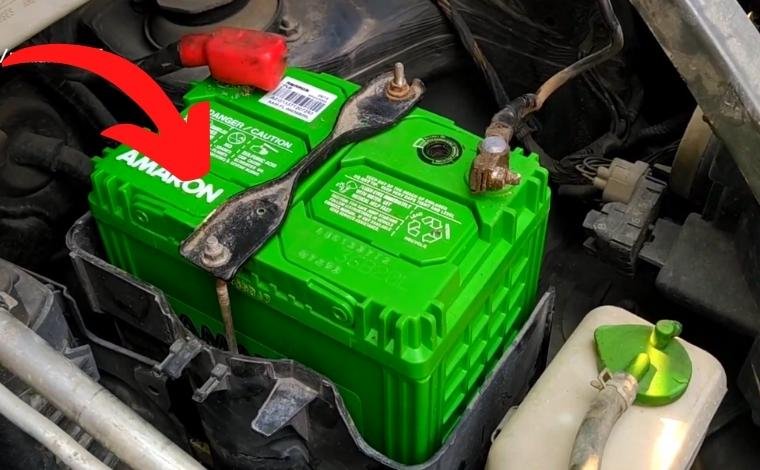
A basic scanner normally cannot confirm:
- The battery’s actual available cold-cranking amps
- Internal plate or cell condition
- Reserve capacity
- Performance under a controlled load
- Whether the battery will hold its charge overnight
For confirmation, you may need a direct measurement at the battery terminals followed by a conductance or load test.
The Battery Diagnosis Confidence Ladder
Instead of treating one voltage number as a final answer, battery diagnosis becomes more reliable when evidence is collected in four levels.
Level 1: Observe the Symptoms
Start with what the vehicle is doing. Slow cranking, repeated clicking, dim lights, electrical resets, and frequent jump-starts suggest that the electrical system needs testing.
Level 2: Look for OBD Evidence
Connect the scanner and examine control-module voltage, voltage-related codes, charging data, and any information available from the battery-management system.
Level 3: Measure at the Battery
Use a digital multimeter directly at the battery terminals. This helps determine whether the scanner’s reading matches the voltage actually available at the battery.
Level 4: Test Battery Performance
Use a conductance or load tester to evaluate whether the battery can deliver adequate current when placed under demand. This is the level that provides stronger evidence of the battery’s internal health.
The higher you move on this ladder, the more confidently you can separate a bad battery from a temporary low state of charge or another electrical problem.
What Different OBD2 Tools Can Tell You
Not every scanner has the same electrical-diagnostic capabilities. A low-cost code reader and an advanced scanner paired with a battery tester should not be treated as equivalent tools.
| Tool Type | Voltage Information | Codes and Module Data | Battery-Health Test |
|---|---|---|---|
| Basic OBD2 code reader | May show control-module or OBD-port voltage | Usually engine and emissions-related codes | Normally unavailable |
| Bluetooth OBD2 adapter | Depends on the adapter, app, and vehicle | Basic or enhanced data depending on software | Usually unavailable without additional hardware |
| Full-system diagnostic scanner | May graph voltage and display module-specific values | May access body, charging, battery-sensor, and communication codes | Limited unless a dedicated test function is included |
| Scanner paired with a clamp-connected battery tester | Direct battery measurement | Vehicle diagnostics plus electrical-system information | Can test battery, cranking, and charging performance |
A product description that says “battery test” should therefore be examined carefully. On one scanner, it may mean nothing more than displaying voltage. On another, it may involve separate clamps and a genuine battery-health assessment.
How Does an OBD2 Scanner Check Battery Voltage?
An OBD2 scanner connects to the vehicle’s diagnostic link connector, normally located under the dashboard. Depending on the tool and vehicle, it may obtain voltage in one of two ways.
The first is control-module voltage reported through live data. This is the voltage being detected by the engine control module or another electronic module. The second may be voltage measured by the scanner or adapter at the diagnostic connector.
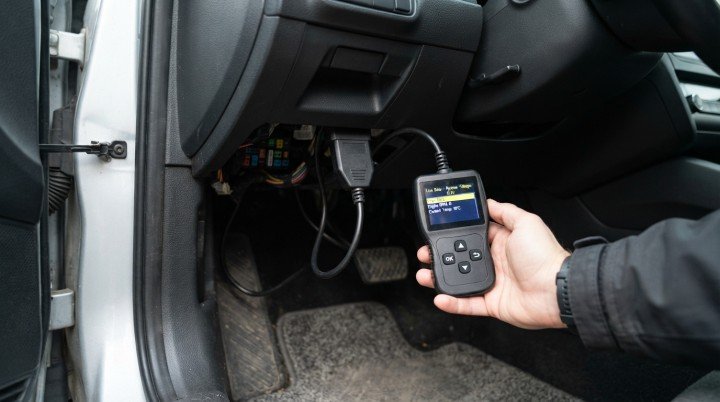
Neither reading is guaranteed to be identical to voltage measured directly across the battery posts. Electricity must travel through cables, grounds, fuses, connectors, and wiring before reaching a module or the OBD port. Resistance anywhere along that route can create a difference.
For example, the battery may measure 12.5 volts at its terminals while the control module reports a slightly lower value. A small difference may be normal, but a significant gap can point toward:
- Loose or corroded battery terminals
- Poor engine or body grounds
- Damaged power cables
- Resistance in a fuse or connector
- A problem within the circuit supplying the control module
This is why a questionable scanner reading should be compared with a multimeter reading taken directly at the battery.
Battery Voltage, State of Charge, and State of Health Are Not the Same
These three terms are often used as though they mean the same thing, but each describes something different.
Battery voltage is the electrical pressure available at the moment of measurement. It can change depending on recent charging, electrical loads, temperature, and whether the engine is running.
State of charge describes how full the battery currently is. A healthy battery may show low voltage simply because the lights were left on or the vehicle has been parked for an extended period.
State of health describes how much performance remains compared with the battery when it was new. An aging battery may reach a normal resting voltage after charging but still be unable to supply enough current to crank the engine reliably.
Consider two batteries that both show approximately the same engine-off voltage. One may start the engine normally, while the other experiences a severe voltage collapse when the starter engages. The resting readings look similar, but their ability to work under load is very different.
That is why a normal voltage reading should not automatically be interpreted as proof that the battery is good.
Battery Problems a Scanner May Help Reveal
A scanner becomes most useful when you examine patterns instead of looking for a single “bad battery” message.
It may reveal low system voltage before starting, an excessive drop during cranking, unstable voltage after the engine starts, or voltage that remains too low or rises too high while the charging system is operating. A full-system scanner may also find low-voltage or communication codes stored across several modules.
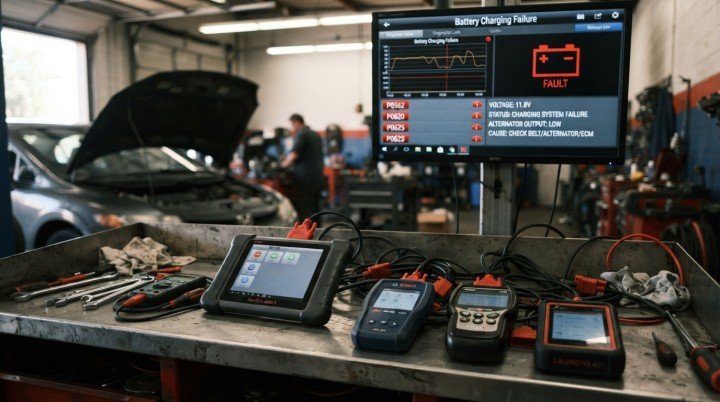
Multiple unrelated codes can sometimes appear after a weak start because electronic modules require stable voltage to operate and communicate. When voltage drops too far, modules may temporarily shut down, lose communication, or record implausible sensor information.
However, these codes identify what the modules experienced—not necessarily which component caused it. The source could be the battery, but it could also be a loose connection, weak alternator, damaged ground, or starter drawing excessive current.
Signs to Check Before Connecting the Scanner
The physical behavior of the vehicle provides context for the scan results. Pay attention if the starter turns more slowly than usual, the dashboard goes dark during cranking, the clock resets, or the vehicle needs frequent jump-starts.
Rapid clicking can mean that voltage falls too low for the starter solenoid to remain engaged. Dim headlights and slow power accessories may also suggest an electrical-supply problem, although charging-system faults and poor connections can create the same symptoms.
Inspect the battery itself when it is safe and accessible. A swollen, cracked, or leaking case is a physical failure that scanner data cannot excuse. Severe terminal corrosion or loose cable connections should also be corrected before the battery is condemned.
How to Test Battery Voltage With an OBD2 Scanner
Park the vehicle in a well-ventilated area, select Park or Neutral, apply the parking brake, and switch off unnecessary electrical accessories. Locate the OBD2 port—usually under the driver’s side of the dashboard—and connect the scanner.

Turn the ignition on without starting the engine. Open the scanner’s Live Data menu and look for a parameter labeled:
- Control Module Voltage
- Battery Voltage
- System Voltage
- ECU Voltage
- Power Supply Voltage
The exact name depends on the scanner and vehicle. Select the graphing function if one is available because a graph may reveal changes that are difficult to notice as rapidly moving numbers.
Record three readings:
- Voltage with the ignition on and engine off
- Lowest visible voltage while the starter is cranking
- Voltage after the engine starts and stabilizes
If possible, repeat the running test with the headlights, blower motor, and rear defroster switched on. The purpose is not to force the voltage toward one universal number. It is to observe whether the electrical system responds consistently when demand increases.
An Important Limitation of the Engine-Off Reading
Most OBD2 scanners need the ignition switched on before they can communicate with the vehicle. Turning on the ignition activates control modules, dashboard electronics, fuel-system components, and other circuits. These loads may lower the voltage compared with a true resting measurement taken directly at the battery.
For that reason, an OBD reading of 12.3 volts with the ignition on does not necessarily mean the rested battery voltage is exactly 12.3 volts. A multimeter placed across the battery terminals after the battery has rested will provide a better open-circuit measurement.
Recent driving can create the opposite problem. The battery may temporarily retain a surface charge and display a reassuring number even though its capacity has deteriorated. Headlights or another small load may need to be applied briefly before a meaningful resting test, but the correct procedure depends on the battery and tester manufacturer.
What Voltage Should a Car Battery Show on an OBD2 Scanner?
The following values are general reference points for a conventional 12-volt lead-acid starting battery. They are not universal pass-or-fail specifications. Temperature, battery chemistry, recent charging, vehicle loads, scanner location, and smart-charging strategy can all affect the reading.
| Test Condition | General Reference | What It May Suggest | Important Limitation |
|---|---|---|---|
| Battery rested, engine off | Around 12.6V or slightly higher | Battery appears well charged | Does not prove that adequate cranking capacity remains |
| Engine off | Around 12.4V | Battery may be partially discharged | Charge and retest before considering replacement |
| Engine off | Around 12.2V | Battery is significantly discharged | The cause could be short trips, lights left on, weak charging, or parasitic drain |
| Engine off | Below approximately 12.0V | Very low state of charge or possible battery problem | A discharged battery is not automatically an internally failed battery |
| During cranking | Often expected to remain near or above 9.6–10V | A severe collapse needs further testing | Temperature, manufacturer specifications, starter draw, and scanner refresh rate matter |
| Engine running | Often approximately 13–15V | The charging system appears active | Smart-charging vehicles may intentionally operate outside a narrow traditional range |
Always compare questionable values with the vehicle manufacturer’s specifications. Battery type also matters: flooded, AGM, and EFB batteries may not follow identical testing and charging behavior.
What Does Voltage Drop During Cranking Mean?
Starting the engine places one of the heaviest electrical demands on the battery. The starter may draw a large amount of current within a fraction of a second, causing voltage to fall temporarily.
A healthy, charged battery should tolerate this demand without an extreme collapse. If voltage drops sharply and the engine turns slowly, possible causes include:
- A weak or discharged battery
- High resistance at the battery terminals
- A damaged positive cable or ground connection
- Excessive current draw from the starter
- Mechanical resistance preventing the engine from turning normally
The commonly referenced 9.6-volt threshold comes from controlled testing conditions and should not be treated as a universal rule for every vehicle or temperature. Cold weather increases starting demand, while different battery designs and vehicle manufacturers may specify different limits.
A scanner has another limitation here: refresh rate. The lowest cranking voltage may exist for such a short time that a slow scanner never displays it. Graphing tools, a min/max multimeter, or a dedicated battery tester are more likely to capture the true minimum.
If the scanner disconnects or restarts during cranking, that behavior may itself suggest a major voltage drop—but it does not identify the cause.
Which OBD2 Codes Can Be Related to Low Voltage?
Low or unstable voltage may store codes even when the check engine light is not illuminated. Examples include:
P0562 — System Voltage Low: A control module detected voltage below the expected range.
P0563 — System Voltage High: The electrical system experienced excessive voltage, potentially involving the charging system or voltage regulation.
A full-system scanner may also reveal manufacturer-specific battery-sensor codes, charging-system codes, lost-communication codes, or undervoltage records in the body, ABS, airbag, transmission, and other modules.
When several unrelated modules store voltage or communication codes at approximately the same time, look for a shared power-supply problem before assuming that every module has failed.
Do not immediately erase the codes. Record them along with their status, freeze-frame information, mileage, and the circumstances in which the problem occurred. Clearing everything before diagnosis may remove useful evidence.
Can an OBD2 Scanner Test the Alternator?
An OBD2 scanner can help evaluate charging behavior, but it may not perform a complete alternator output test.
Start the engine and observe system voltage. In many conventional systems, the value should rise above the engine-off reading as the alternator begins charging. Switch on major electrical loads and watch whether the system remains stable.
Possible warning patterns include:
- Voltage remains close to the discharged engine-off value
- Voltage repeatedly falls as loads are added
- Voltage rises excessively
- Output fluctuates sharply without an obvious change in demand
- Charging voltage changes with RPM alongside dimming or brightening lights
These patterns may point toward the alternator, voltage regulator, drive belt, cables, grounds, or battery-current sensor. They do not automatically prove that the alternator itself needs replacement.
Modern smart-charging systems make interpretation more complicated. The engine computer may raise or lower alternator output based on battery state of charge, temperature, acceleration, deceleration, and electrical demand. A running voltage that temporarily falls near normal battery voltage may be commanded operation rather than failure.
An advanced scanner may display generator command, battery current, battery state of charge, or intelligent battery-sensor data. Comparing commanded output with actual behavior is more useful than judging the alternator from one number.
Can a Battery Show Good Voltage and Still Be Bad?
Yes. This is one of the most important limitations of voltage-only diagnosis.
Imagine a battery that displays 12.6 volts after being charged. With no major load applied, the reading looks healthy. When the starter engages, however, internal deterioration prevents the battery from delivering sufficient current and the voltage collapses.
This can happen because open-circuit voltage mainly reflects state of charge. It does not directly measure:
- Available cranking amps
- Internal resistance
- Reserve capacity
- Plate deterioration
- The battery’s ability to hold charge
A recently charged battery may also carry a temporary surface charge that makes the initial reading look better than its actual condition. Conversely, a healthy battery may show low voltage because it is discharged rather than permanently damaged.
What an OBD2 Scanner Cannot Tell You About the Battery
A basic scanner communicates with vehicle modules through the diagnostic port. It does not place a controlled electrical load directly across the battery terminals. Therefore, it usually cannot measure:
- Actual available cold-cranking amps
- Reserve capacity
- Internal plate or cell condition
- Performance under a specified load
- How long the battery will hold its charge
- The precise source of an overnight battery drain
- Remaining battery lifespan
Some apps or scanners display a battery percentage, but that number may represent estimated state of charge, voltage converted into a percentage, or information reported by the vehicle’s battery-management system. It should not automatically be interpreted as laboratory-confirmed battery health.
Can an OBD2 Scanner Perform a Battery Load Test?
A conventional OBD2 scanner cannot perform a true battery load test through the diagnostic connector. A load test requires a tester connected directly to the battery, where it can apply or observe significant current demand and measure how well the battery maintains voltage.
Some advanced diagnostic packages advertise battery testing because they include or support a separate clamp-connected battery tester. In that arrangement, the diagnostic tablet communicates with the vehicle through the OBD port while the external tester measures the battery directly.
The two connections perform different jobs:
OBD connection: Reads codes, module data, battery-sensor information, and charging commands.
Battery-clamp connection: Measures battery voltage, conductance, available cranking capacity, starting performance, and charging behavior.
Before relying on a positive answer to Can an OBD2 Scanner Detect a Bad Battery, check exactly how the advertised battery-test function works. If the tool has no direct connection to the battery and provides only a voltage screen, it probably offers useful monitoring rather than a complete health test.
Five Problems That Can Look Like a Bad Battery
Battery replacement is often treated as the quickest solution to a no-start or slow-crank condition. However, replacing it will not provide a lasting fix if another part of the electrical system caused the problem.

1. The Battery Is Discharged but Not Internally Failed
A healthy battery can become discharged after lights are left on, the vehicle remains parked for a long period, or repeated short trips do not allow enough recharging time.
Low voltage shows that the battery needs attention, but it does not explain why the charge is low. The battery should be charged correctly and retested before it is condemned, unless it is physically damaged or the manufacturer’s test procedure says otherwise.
2. The Alternator Is Not Recharging the Battery
A failing alternator, voltage regulator, drive belt, cable, fuse, or charging-control circuit can leave a good battery undercharged. The vehicle may start after a jump but lose electrical power again because the battery is not being replenished.
Installing a new battery may temporarily hide the problem. Once the replacement battery discharges, the same symptoms return.
3. A Parasitic Drain Is Emptying the Battery
Vehicles continue using a small amount of power after being switched off. Modules, alarms, keyless-entry systems, and memory circuits require normal standby current.
A light that remains on, a module that never goes to sleep, an aftermarket accessory, or damaged wiring can increase that draw and discharge the battery overnight. A scanner may help identify modules that remain active on some vehicles, but an accurate parasitic-draw test normally requires appropriate current measurement and a vehicle-specific sleep procedure.
Leaving certain Bluetooth OBD2 adapters connected can also keep a network awake or consume power. Remove the adapter when it is not being used unless the manufacturer confirms that it is designed for continuous connection.
4. Battery Cables or Grounds Have Excessive Resistance
Corrosion or looseness may restrict current even when battery voltage looks normal. The starter then receives less voltage than the battery can provide.
A visual inspection may not find resistance hidden inside a cable or beneath insulation. A voltage-drop test performed while the circuit is under load can reveal whether too much voltage is being lost between the battery, starter, engine block, and vehicle body.
5. The Starter Is Drawing Too Much Current
An internally worn or mechanically binding starter can draw excessive current and pull system voltage down. The resulting slow crank may look almost identical to a weak battery.
Battery voltage, cranking current, cable voltage drop, and engine mechanical condition may all need to be considered before either the starter or battery is replaced.
OBD2 Scanner vs Multimeter vs Battery Tester
No single tool is ideal for every stage of electrical diagnosis.
| Tool | What It Measures | What It Does Well | Main Limitation |
|---|---|---|---|
| Basic OBD2 scanner | Module voltage, live data, and supported trouble codes | Finds electrical clues without disconnecting components | Usually cannot measure battery capacity under load |
| Digital multimeter | Direct voltage, resistance, and current when used correctly | Terminal-voltage, voltage-drop, and parasitic-draw testing | Does not automatically calculate battery health |
| Conductance battery tester | Voltage, conductance, and estimated available cranking power | Quickly evaluates battery condition and CCA performance | Correct battery type, rating, and test setup must be entered |
| Battery load tester | Voltage response under a controlled electrical load | Shows whether the battery can support substantial demand | Must be used according to its instructions and battery specifications |
| Advanced scanner with external battery tester | Vehicle data plus direct battery, starting, and charging measurements | Combines module diagnosis with battery-system testing | Costs more and may require vehicle coverage or software updates |
How to Confirm Whether the Battery Is Actually Bad
A practical confirmation process should move from simple observations to tests that place the battery under demand.
First, inspect the case, terminals, cables, and grounds. A cracked, leaking, or badly swollen battery should be handled cautiously and normally requires replacement rather than further routine testing.
Next, check voltage directly at the battery terminals. If the battery is discharged, charge it using a charger appropriate for its type. AGM, EFB, flooded lead-acid, and other battery designs may require different settings.
After charging, allow the battery to stabilize as directed by the tester or battery manufacturer. Then perform a conductance or load test using the correct battery type, rated CCA, and temperature considerations.
A complete electrical assessment may also include:
- Battery-health test
- Cranking-voltage and starter-current test
- Positive and negative cable voltage-drop tests
- Alternator output and charging-control test
- Parasitic-draw test if the battery repeatedly goes flat
If the battery passes after charging but becomes discharged again, replacing it immediately may miss a charging problem or key-off drain.
When Should You Replace the Battery?
Replacement becomes reasonable when testing identifies a bad cell, the battery fails an appropriate load or conductance test after being fully charged, or it cannot retain its charge despite the vehicle’s charging system and key-off draw testing normally.
Physical damage can make further diagnosis unnecessary. Replace a battery that is cracked, leaking, or severely swollen, and inspect the charging system because overcharging or excessive heat may have contributed to the damage.
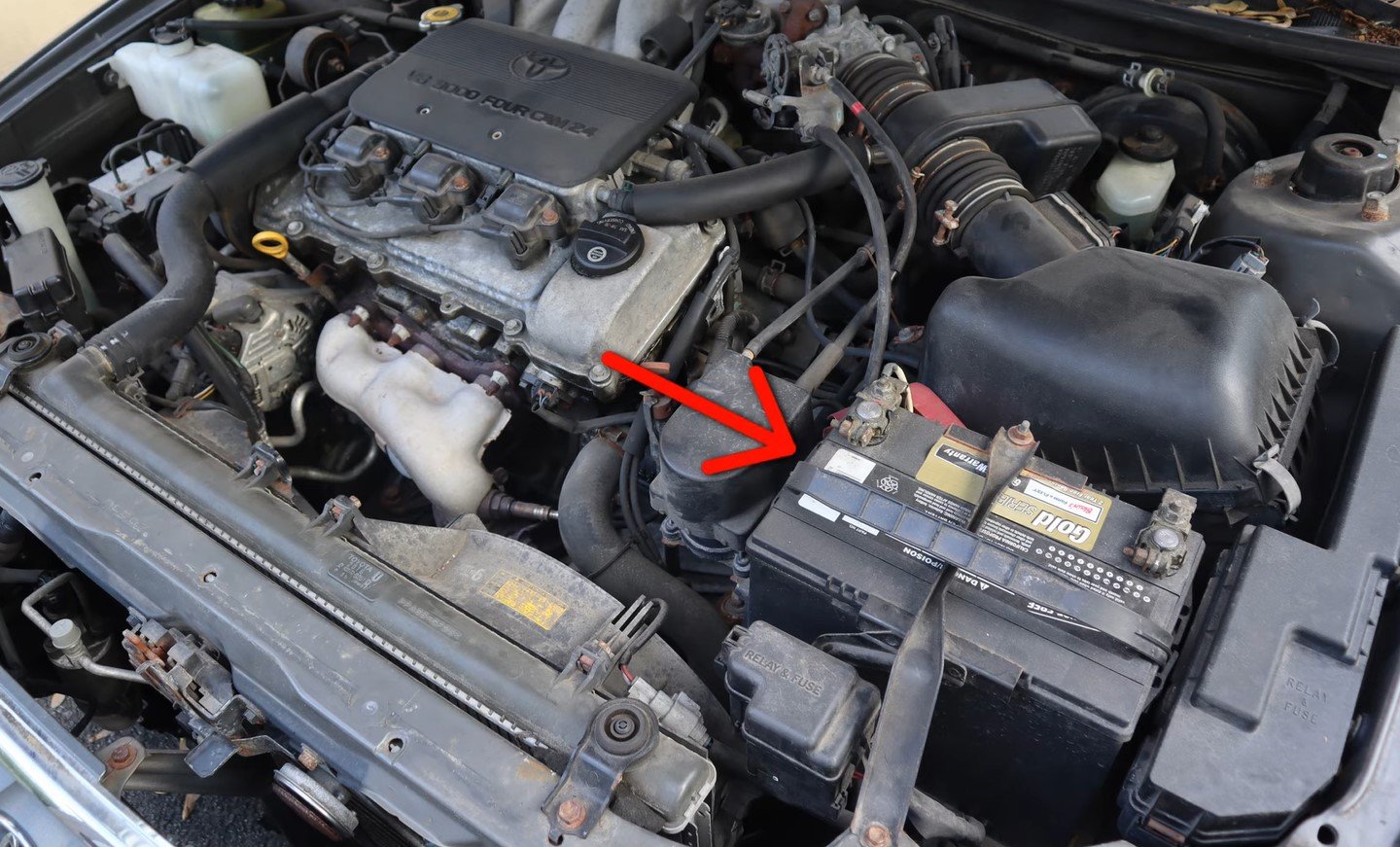
Battery age provides context but should not be the only deciding factor. Climate, operating conditions, vibration, maintenance, battery construction, and charging history all affect lifespan. An older battery with starting symptoms deserves prompt testing, while age alone does not explain a new battery that repeatedly goes flat.
Frequently Asked Questions
Q1: Can a Cheap OBD2 Scanner Check Battery Voltage?
A1: Many inexpensive scanners can display control-module or diagnostic-port voltage. Check the specifications because some basic readers show voltage only during startup, while others provide it through Live Data. This remains a voltage clue rather than a complete battery-health test.
Q2: Can a Bluetooth OBD2 Scanner Detect a Weak Battery?
A2: It may display voltage and related codes if the adapter, app, and vehicle support the required data. Graphing can help reveal trends, but the adapter cannot directly measure battery capacity unless it works with additional battery-testing hardware.
Q3: Can a Bad Battery Cause OBD2 Codes?
A3: Yes. Low or unstable voltage can cause system-voltage codes, communication codes, sensor-reference problems, and several unrelated module faults. The stored code identifies what a module detected; it does not always identify the component that caused the voltage loss.
Q4: Will a Bad Battery Always Store a Trouble Code?
A4: No. A battery can have reduced capacity or fail during cranking without storing a useful code. Some scanners may also access only the engine module and miss undervoltage records stored in other systems.
Q5: Can an OBD2 Scanner Check Battery CCA?
A5: A standard OBD2 connection cannot directly test available CCA. A tool needs a compatible external battery tester connected to the terminals to estimate cranking performance properly.
Q6: Can an OBD2 Scanner Detect a Parasitic Drain?
A6: A scanner may show module status, battery-current-sensor data, or a device that remains awake on supported vehicles. However, it generally cannot replace a proper key-off current test. The diagnostic procedure must also allow time for vehicle modules to enter sleep mode.
Final Verdict
So, Can an OBD2 Scanner Detect a Bad Battery? It can detect evidence that points toward one: low module voltage, abnormal cranking behavior, unstable charging data, or voltage-related codes. Advanced scanners may provide even more useful battery-management information.
What a basic scanner usually cannot do is confirm internal battery condition. Treat scan data as a direction for testing, not as the final replacement decision. Direct terminal measurements, a proper battery-health or load test, and checks of the cables, starter, alternator, and parasitic draw provide the strongest diagnosis—and help prevent a good battery from being replaced for the wrong reason.