
You’re cruising down the highway at 60 mph when the steering wheel starts vibrating in your hands. Slow down to 40 mph, and the shaking almost disappears. It may feel like a minor annoyance, but it’s worth finding out what’s happening.
When your steering wheel shakes while driving, the problem often starts with the tires or wheels. An unbalanced wheel is a common cause, but damaged tires, worn steering parts, bent rims, and suspension problems can produce similar symptoms.
The timing tells you a lot. Does the steering wheel shake only at highway speeds, when you brake, or after hitting a pothole?
Before paying for an alignment or replacing expensive parts, here’s how to narrow down seven possible causes and recognize symptoms that shouldn’t be ignored.
Quick AnswerA steering wheel that shakes while driving is commonly caused by unbalanced wheels, uneven tire wear, damaged tires, or bent rims. Worn tie rods, suspension joints, wheel bearings, and brake problems are other possibilities. If vibration occurs mainly between 50 and 70 mph, check wheel balance and tire condition first. Sudden or severe shaking requires immediate attention.
Why Does My Steering Wheel Shake While Driving?
Your steering wheel is connected to the front wheels through a system of steering and suspension components. When something causes the wheels to rotate unevenly or move excessively, that movement can travel through the steering system and reach your hands.
The first clue is whether the shaking follows vehicle speed, braking, acceleration, or road conditions.
| When the Shaking Happens | What to Check First |
|---|---|
| Between 50 and 70 mph | Wheel balance, tire condition, wheel runout |
| At low speeds | Tire damage, bent wheel, loose steering parts |
| Only when braking | Front rotors, calipers, suspension |
| During acceleration | CV axles, drivetrain, tires |
| While turning | Wheel bearings, steering joints, CV joints |
| After hitting a pothole | Wheel, tire, suspension damage |
These are starting points rather than confirmed diagnoses. A tire problem can appear at several speeds, and more than one worn component may contribute to the same vibration.
7 Reasons Your Steering Wheel Shakes While Driving
1. Unbalanced Tires or Wheels
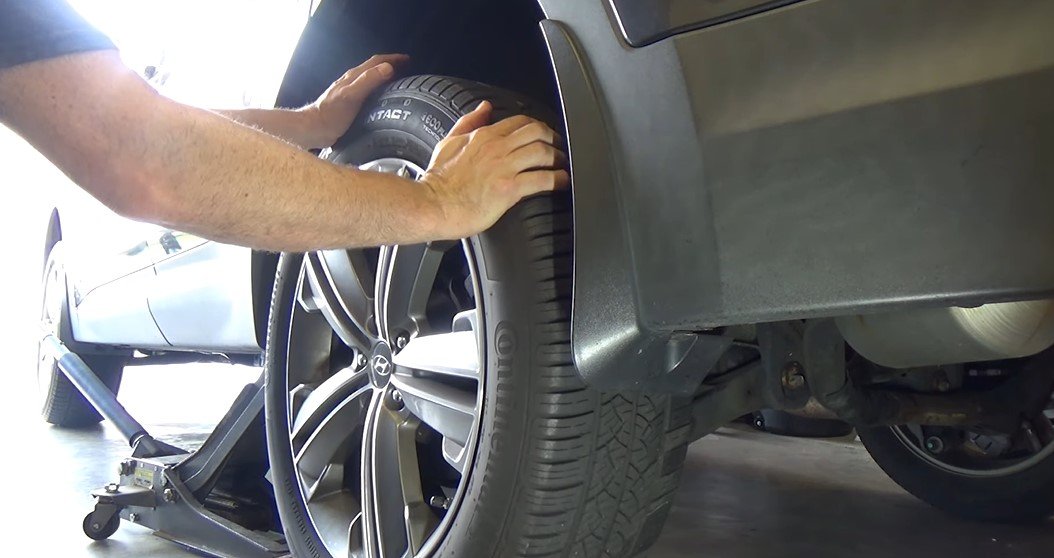
Wheel imbalance is one of the first things to investigate when the steering wheel shakes at highway speeds.
A tire-and-wheel assembly needs its weight distributed evenly around the wheel. Even a small imbalance can create vibration as the assembly rotates.
It may feel smooth at 30 mph but start shaking around 55 or 65 mph. Sometimes the vibration fades again at a different speed.
Common causes include missing wheel weights, uneven tire wear, or a wheel that wasn’t balanced correctly after tire installation.
Signs to look for:
- Steering wheel vibration within a particular speed range.
- Shaking that improves when you slow down.
- No obvious brake pedal pulsation.
- Vibration beginning after tire replacement or rotation.
What to check first: Have the front tire-and-wheel assemblies inspected and dynamically balanced. If balancing doesn’t solve the problem, ask about wheel runout and tire road-force variation rather than paying for another identical balancing service.
2. Damaged Tires or Uneven Tire Wear
A tire doesn’t have to be completely flat to cause steering wheel vibration.
Internal belt separation, flat spots, sidewall bulges, or uneven tread wear can make a tire roll irregularly. When that damaged tire is on the front axle, the movement may be noticeable through the steering wheel.
For example, a tire with internal structural damage might thump at low speeds and shake more intensely as speed increases.
Common tire problems include:
- Cupping: Irregular low and high spots across the tread.
- Flat spotting: A section of the tire becoming temporarily or permanently flattened.
- Belt separation: Internal damage that may distort the tire’s shape.
- Sidewall bulges: Localized swelling that can indicate internal structural damage.
Incorrect tire pressure may also contribute to unusual handling and tire wear. If your dashboard pressure warning is illuminated, check the tires before investigating other causes. Our TPMS diagnostic tool guide explains the equipment used for tire-pressure monitoring problems.
What to check first: Inspect the tread and sidewalls for damage and check cold tire pressure against the driver’s door-jamb label. A tire with a bulge or suspected belt separation shouldn’t be driven on; arrange professional replacement.
3. Bent Wheels or Incorrect Wheel Mounting
Hitting a pothole or curb can bend a wheel even if the damage isn’t visible from the outside.
The inner edge of the rim may be bent while the front looks normal. As the wheel rotates, the tire moves slightly off its intended path, creating a repeated vibration.
Incorrect wheel mounting can produce similar symptoms. This includes wheels that aren’t seated properly against the hub or aftermarket wheels with an incorrect center-bore fit.
Loose wheel fasteners are particularly dangerous because they can allow unwanted movement and potentially lead to wheel separation.
Warning signs include shaking after a pothole impact, visible rim damage, repeated balancing problems, or an unusual knocking sensation.
What to check first: Have the wheel checked for radial and lateral runout. Confirm the mounting surfaces, wheel fitment, and fastener torque meet the vehicle manufacturer’s specifications. Don’t continue driving if wheel looseness is suspected.
4. Worn Tie Rod Ends or Steering Components
Tie rods connect the steering mechanism to the front wheels. They allow the wheels to follow your steering input accurately.
As the joints wear, they can develop excessive play. That looseness may create steering instability, especially over bumps or when the wheels encounter uneven road surfaces.

You may notice the steering wheel shaking along with:
- Loose or vague steering response.
- Clunking noises over rough pavement.
- The vehicle wandering instead of tracking straight.
- Uneven front tire wear.
Worn tie rods aren’t always the primary cause of a smooth-road, speed-specific vibration. However, they can make an existing tire or wheel problem feel worse.
What to check first: Have the inner and outer tie rod ends inspected for excessive play. Replace defective parts and perform wheel alignment when required. Don’t assume an alignment alone will repair worn steering joints.
5. Worn Ball Joints, Bushings, or Suspension Parts
Your suspension keeps the tires properly positioned while allowing the wheels to move over bumps.
Ball joints, control arm bushings, and other suspension components control that movement. When they wear, the wheels can shift more than intended.
A worn control arm bushing may allow unwanted movement during acceleration, braking, or cornering. A severely worn ball joint can create unstable steering and presents a serious safety risk.
Look for clunking sounds, uneven tire wear, poor handling, or shaking that changes on rough roads.
What to check first: Have a technician inspect ball joints, control arms, bushings, and shock or strut condition. Repair any confirmed looseness before attempting to correct alignment.
Suspension problems can produce vibrations that resemble wheel imbalance, which is why accurate diagnosis matters.
6. Brake Rotor or Sticking Caliper Problems
If the steering wheel vibrates mainly when you press the brake pedal, the braking system deserves attention before wheel balancing.
Uneven brake rotor thickness can create changing braking forces as the rotor rotates. These forces may travel through the front suspension and steering system.
This is often called a warped rotor, although disc thickness variation or uneven friction-material deposits may be the actual issue.
A sticking caliper may also overheat the brakes, create uneven pad wear, or cause the vehicle to pull while slowing down.
Other signs include brake pedal pulsation, grinding, a burning smell, or shaking during downhill braking.

What to check first: Have rotor thickness variation, runout, brake pad condition, and caliper operation inspected. Avoid replacing rotors without confirming the fault and checking the underlying cause.
7. Worn Wheel Bearings or CV Axle Problems
Wheel bearings allow your wheels to rotate smoothly while supporting vehicle loads. A failing bearing can create humming or growling that changes with road speed.
In more advanced cases, bearing play can contribute to wheel instability or vibration.
CV axle problems behave somewhat differently. A worn inner CV joint may create vibration during acceleration, especially in front-wheel-drive vehicles.
An outer CV joint commonly produces clicking noises during turns when damaged.
Useful clues include:
- Humming or rumbling that changes with vehicle speed.
- Vibration becoming stronger under acceleration.
- Clicking noises during tight turns.
- Damaged CV boots or grease leakage.
What to check first: Have the wheel bearings checked for noise, roughness, and excessive play. If vibration is related to acceleration, inspect the CV axles and joints. Replace only the component confirmed to be defective.
What Does Steering Wheel Shaking at Different Speeds Mean?
Vehicle speed helps narrow the possibilities, but there isn’t one speed that proves a particular part has failed.
Steering Wheel Shakes at 30–40 MPH
Noticeable shaking at low speeds can point toward an out-of-round tire, bent wheel, or significant tire damage. Loose steering and suspension components may also create wobbling, especially on rough pavement.
Don’t overlook obvious tire damage simply because the car still drives.
Steering Wheel Shakes at 50–70 MPH
When your steering wheel shakes while driving around 60 mph but feels normal at lower speeds, wheel imbalance becomes a strong possibility.
Tire road-force variation and bent rims can cause similar symptoms. A vibration occurring within a narrow speed range is not automatic proof that balancing is the only repair needed.
Steering Wheel Shakes Above 70 MPH
A wheel or tire problem that is barely noticeable at lower speeds may become more pronounced at highway speeds.
Don’t accelerate further just to see whether the shaking gets worse. Arrange a tire, wheel, and steering inspection instead.
Why Does My Steering Wheel Shake After New Tires or Balancing?
You bought a new set of tires, had the wheels balanced, and expected a smooth ride. Instead, the steering wheel still vibrates.
This doesn’t necessarily mean the tires are defective.
Possible explanations include incorrect balancing, improper wheel mounting, a bent rim, or tire road-force variation.
Standard wheel balancing corrects uneven weight distribution. A road-force balancing machine also applies a load against the rotating tire to help detect force variation that may cause vibration.
Some tires can be dynamically balanced yet still create noticeable vibration because they aren’t perfectly uniform under load.
Other issues worth checking include:
- A tire bead that hasn’t seated properly.
- Dirt or corrosion on wheel mounting surfaces.
- Incorrect fitment of aftermarket wheels.
- An existing suspension or steering problem.
Before buying another set of tires: Return to the tire shop and explain when the vibration begins. Ask whether the wheel assemblies have been checked for runout and road-force variation, not just conventional balance.
Wheel Balancing vs. Wheel Alignment: Which One Fixes Steering Vibration?
Balancing and alignment are different services, even though they’re often recommended together.
| Wheel Balancing | Wheel Alignment |
|---|---|
| Corrects uneven rotating weight | Adjusts wheel and suspension angles |
| Often fixes speed-related vibration | Helps correct pulling and uneven tire wear |
| Uses a wheel balancing machine | Uses alignment measuring equipment |
| Doesn’t repair bent rims | Doesn’t correct wheel imbalance |
| Common after new tire installation | Often needed after steering or suspension repairs |
If the steering wheel shakes at 60 mph without pulling, balancing and tire condition are sensible first checks.
If your car pulls left or right, the steering wheel sits off-center, or tires wear unevenly, alignment and suspension condition become more relevant.
Misalignment can contribute to irregular tire wear that eventually causes vibration, but adjusting wheel angles doesn’t directly fix an unbalanced tire.
Why Does My Steering Wheel Shake When Braking or Accelerating?
Shaking When Braking
Vibration that begins when you press the brakes is different from shaking that happens during steady cruising.
Brake rotor thickness variation, sticking calipers, or worn suspension parts may be responsible. If the brake pedal pulses rhythmically, rotor-related braking force variation is worth investigating.
Don’t assume a wheel balancing service will cure vibration that appears only while braking.
Shaking When Accelerating
If the steering wheel or entire car shakes when you accelerate, the drivetrain may be involved.
Worn inner CV joints can create load-dependent vibration. Engine misfires or worn engine mounts may cause whole-vehicle shaking that feels different from a wheel-related shimmy.
If acceleration-related shaking is accompanied by a check engine light, our OBD2 trouble code guide explains how diagnostic codes can help identify engine and electronic faults.
What Should You Check First If Your Steering Wheel Vibrates?
Instead of replacing parts based on guesses, follow this order.
- Identify the driving condition. Note whether the vibration appears at a particular speed, while braking, during acceleration, or on rough roads.
- Inspect tires and check pressure. Look for bulges, obvious tread damage, and irregular wear. Check cold tire pressure using the manufacturer’s label.
- Consider recent impacts or tire service. A pothole impact, tire replacement, or wheel installation immediately before the shaking began is an important clue.
- Request wheel and tire testing. When vibration is speed-related, balancing and wheel runout measurements are logical first steps. Road-force testing may help if ordinary balancing fails.
- Inspect steering and suspension. If tire and wheel checks are normal, have tie rods, ball joints, bushings, and wheel bearings evaluated.
- Investigate brakes or electronic faults when symptoms justify it. Brake-only vibration needs brake inspection. Warning lights or unusual electronic steering behavior may require diagnostic scanning.
Safety first: Don’t attempt to tighten wheel fasteners, jack up the vehicle, or inspect suspension joints without the correct equipment and procedures. If you suspect a loose wheel or unstable steering, stop driving and arrange professional assistance.
Can an OBD2 Scanner Diagnose a Shaking Steering Wheel?
An OBD2 scanner can help with certain electronic problems, but it cannot directly measure wheel imbalance, tire damage, or worn suspension joints.
Most basic code readers focus on engine and emissions-related faults. A scanner displaying no codes doesn’t prove your wheels or steering components are safe.
When an Advanced Scanner May Help
On compatible vehicles, advanced diagnostic tools may retrieve faults from ABS, electronic power steering (EPS), or other control modules.
They may help investigate:
- ABS wheel-speed sensor faults.
- Electronic power steering warning lights.
- Steering angle sensor errors.
- Engine misfires causing whole-vehicle vibration.
If the ABS or traction-control warning is illuminated, our TRAC OFF warning light guide explains related system faults and warning behavior.
For tools with enhanced diagnostics, see the Innova 5610 scanner review and the Innova 5510 review. Both discuss functions beyond ordinary engine-code reading.
Some advanced tools also support steering-angle calibration after certain repairs. Our Autel MK808TS review covers relevant service capabilities.
Always confirm vehicle-specific coverage before choosing diagnostic equipment. Scanner functions cannot substitute for physical inspection of tires, wheels, or steering components.
How Much Does It Cost to Fix a Shaking Steering Wheel?
Costs depend on the actual cause, vehicle model, and local labor rates. The following are broad U.S. budgeting estimates rather than guaranteed 2026 shop quotes.
| Service or Repair | Typical Estimated Cost |
|---|---|
| Wheel balancing | $15–$40 per wheel |
| Wheel alignment | $80–$200 |
| Road-force balancing | $25–$60 per wheel |
| Tire replacement | $100–$350+ per tire |
| Bent wheel repair | $75–$200+, if safely repairable |
| Tie rod replacement | $150–$450+ per side |
| Control arm replacement | $250–$800+ per component |
| Wheel bearing replacement | $250–$700+ per wheel |
| Brake rotor and pad service | $300–$900+ per axle |
Some vehicles cost substantially more, and repairs involving steering components may require alignment afterward.
Start with the inspection suggested by your symptoms. Paying for an unnecessary alignment won’t fix an out-of-balance wheel, and installing new tires won’t repair a loose tie rod.
Is It Safe to Drive With a Shaking Steering Wheel?
It depends on how severe the vibration is and what’s causing it.
A mild, consistent highway-speed vibration may come from wheel imbalance. It still deserves inspection, but it doesn’t automatically mean the steering system is about to fail.
Other symptoms are much more concerning.
Stop safely and arrange assistance if you notice:
- Sudden or severe steering wheel shaking.
- A bulging, damaged, or rapidly deflating tire.
- Loose or unpredictable steering response.
- Loud clunking or grinding near a wheel.
- Strong pulling or difficulty maintaining control.
- Severe vibration immediately after hitting a pothole.
- Suspected loose wheel fasteners.
When tire, wheel, or steering failure is possible, towing is safer than continuing to drive.
One exception worth knowing: some vehicles use a brief steering-wheel vibration as a lane-departure warning. This usually happens when the vehicle detects an unintended lane crossing.
Check your owner’s manual if the vibration occurs only with a driver-assistance alert. Continuous shaking at a particular road speed isn’t typical lane-warning behavior.
How to Prevent Steering Wheel Vibration From Returning
Routine tire and suspension maintenance can reduce the chance of recurring vibration.
- Check cold tire pressure monthly.
- Rotate tires according to the vehicle manufacturer’s schedule.
- Balance tires when replacing them or when vibration develops.
- Inspect uneven tread wear before it becomes severe.
- Have wheels and suspension checked after major pothole impacts.
- Repair worn steering components promptly.
- Ensure wheel mounting and fastener torque are correct after service.
These checks are particularly useful before long highway trips.
Frequently Asked Questions
1. Why does my steering wheel shake at 60 mph but not at lower speeds?
Wheel imbalance is a common cause of steering-wheel vibration around 60 mph. Tire road-force variation, damaged tires, and bent wheels can create similar symptoms. Start with tire inspection and wheel balancing rather than assuming the vehicle needs an alignment.
2. Can bad wheel alignment cause my steering wheel to shake?
Misalignment usually causes pulling, uneven tire wear, or an off-center steering wheel rather than a strong speed-specific vibration. However, irregular tire wear resulting from poor alignment can eventually contribute to shaking.
3. Why does my steering wheel still shake after tire balancing?
The wheel may have been balanced incorrectly, or the problem may involve tire road-force variation, a bent rim, improper mounting, or worn suspension parts. Road-force testing and wheel runout measurements may identify problems conventional balancing misses.
4. Can a bad wheel bearing cause steering wheel vibration?
Yes, particularly if the bearing has developed excessive play or significant internal damage. However, humming or growling that changes with vehicle speed is often a more noticeable early symptom. Bearing problems should be confirmed through proper inspection.
5. Why does my steering wheel shake when accelerating but not braking?
A worn inner CV joint or other drivetrain problem may cause vibration under acceleration. Tire and wheel issues can also contribute. If the entire vehicle shakes and the engine runs roughly, an engine-related problem may be involved instead.
6. Can I drive with a slightly shaking steering wheel?
A mild vibration may come from wheel imbalance, but you shouldn’t assume the cause is harmless. Arrange a timely inspection. If the shaking becomes severe, steering feels loose, or tire damage is visible, stop safely and seek assistance.
Final Thoughts
When your steering wheel shakes while driving, start by identifying exactly when the vibration happens.
For shaking at highway speeds, tire condition and wheel balance are sensible first checks. Vibration during braking, acceleration, or turning may point toward different components.
Don’t replace tires, brake rotors, or suspension parts based on guesses. A proper inspection can help you identify the actual problem, avoid unnecessary repairs, and restore smooth, predictable steering.